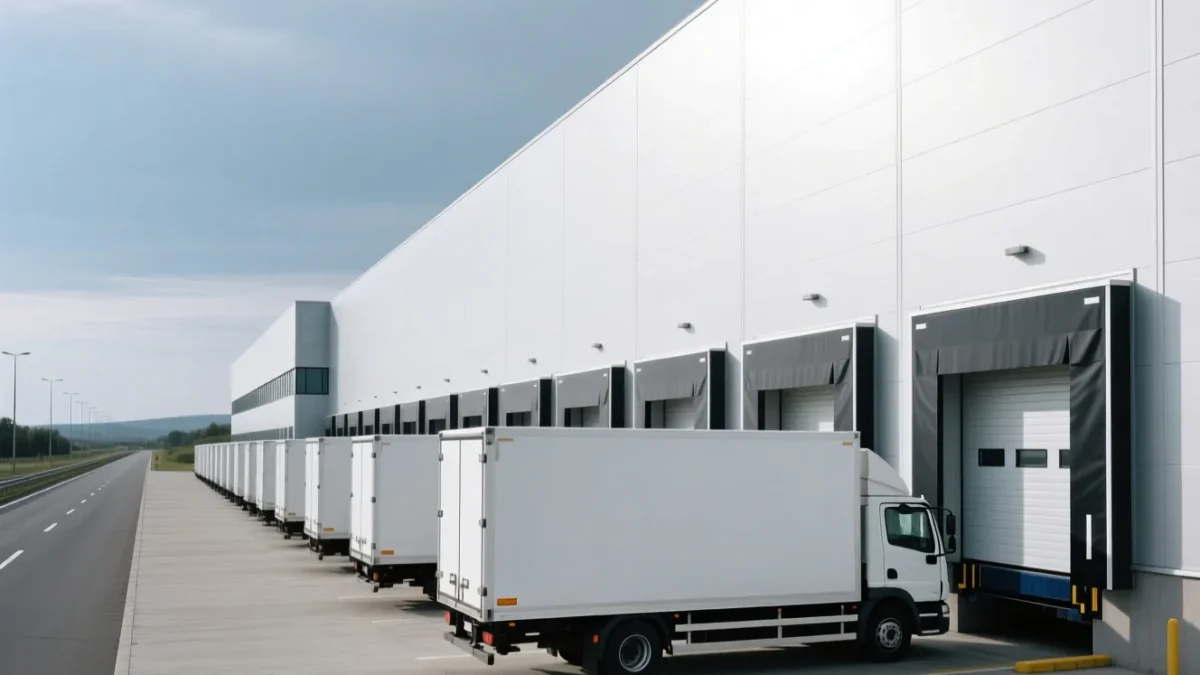
Since mid-2025, Slovakia’s warehouse market has grown and emptied at the same time. Slovakia’s warehouse and industrial property market in 2026 sends two signals that look, at first glance, incompatible. Total modern stock grew from 4.64 million sqm (as of Q2 2025) to 4.87 million sqm in the first quarter of 2026, and leasing activity accelerated — yet the vacancy rate rose from 7.97% to 8.12% over the same span. According to CBRE Slovakia, space is being leased at record pace while empty square metres keep accumulating. This analysis explains why both figures hold true at once, and what that means for tenants, developers and investors.
A stock that added a quarter of a million square metres in three quarters
The starting point is unambiguous: total modern warehouse and industrial stock in Slovakia reached 4.87 million sqm in the first quarter of 2026, up from 4.64 million sqm in the mid-2025 readings. According to CBRE Slovakia (Q1 2026), that is a gain of roughly a quarter of a million square metres in under a year — a pace that places Slovakia among Central Europe’s most dynamic logistics markets relative to its size.
The growth did not arrive suddenly. In the third quarter of 2025, 124,000 sqm of new space came to market, with a further 151,000 sqm in the pipeline for completion by the end of 2025, per CBRE Slovakia (as of Q3 2025). In the first quarter of 2026, developers completed and handed over 83,000 sqm while holding 178,000 sqm under construction, with all of that delivery scheduled across 2026. In other words, construction did not stall — on the contrary, the pipeline remains full and new supply will keep reaching the market throughout the year.
It is precisely in this delivery rhythm that the first part of the vacancy paradox lies. When a developer completes a Class A hall, it counts toward the stock immediately, yet filling it with tenants is a process that takes months. The lag between completion and full lease-up creates a temporary reserve of vacant space even in a market that demand has not abandoned.
Take-up accelerated, but supply outran demand
Leasing activity speaks plainly. Take-up in the first quarter of 2026 reached 136,000 sqm, of which net take-up — new absorption excluding renegotiations of existing leases — accounted for 59,000 sqm. For comparison, third-quarter 2025 take-up came to around 80,000 sqm, with a net component above 44,000 sqm. According to CBRE Slovakia, demand therefore accelerated markedly quarter on quarter.
How, then, can vacancy have risen despite such strong take-up? The answer lies in the balance of two flows. If the market completes and puts under construction hundreds of thousands of square metres of new supply in a single quarter, while net absorption reaches 59,000 sqm, a gap opens. New supply simply outpaces the speed at which tenants absorb it. The result is a modestly rising vacancy rate — from 7.97% (as of Q3 2025) to 8.12% (as of Q1 2026) — even as the leased-space figure itself sets records.
This relationship is healthier than it looks. Rising vacancy in a market where stock and take-up are both growing signals supply responding to demand ahead of time — not a collapse in interest. The dangerous scenario is the reverse: rising vacancy alongside falling take-up, which would point to structural weakness. Slovakia’s market in 2026 is not in that state.
Prime rent rises, but the average falls
The pricing picture is subtler than any single figure would suggest. Prime headline rent — the achievable rent for the highest-quality space in the most sought-after locations — rose from €5.80/sqm/month (as of H1 2025) to €5.95/sqm/month in the first quarter of 2026, per CBRE Slovakia. The top of the market, in other words, is getting more expensive.
More telling, however, is the average rent, which moved in the opposite direction over the same period — from roughly €4.70/sqm/month to €4.55/sqm/month. This spread between a rising prime and a falling average is not a statistical anomaly but a direct consequence of the supply mix. As a new wave of modern halls reaches the market across various regions — including locations with higher vacancy — the market-wide average is diluted by cheaper space, while the most sought-after premises in the Bratislava region hold and lift their pricing.
For a tenant, this means a differentiated market: anyone needing a Class A hall in the immediate vicinity of Bratislava faces rising rent and limited choice, while anyone willing to move further out along the D1 corridor to the west finds more competitive terms. For a developer the message is just as legible — pricing power is concentrated in the prime segment, not spread across the board.
What drives demand: automotive, 3PL and e-commerce
The structure of demand explains why the Slovak logistics market remains resilient. According to CBRE Slovakia (as of Q1 2026), the automotive sector accounted for 31% of demand in the first quarter, third-party logistics (3PL) for 30%, e-commerce for 17%, retail for 11% and manufacturing for 10%. The first two sectors together cover more than sixty percent of the market — and both are structural rather than cyclical for Slovakia.
The automotive industry is a long-standing driver of Slovak industrial property. The just-in-time (JIT) and just-in-sequence (JIS) logistics models on which car production depends require dense networks of warehouses and distribution halls within reach of assembly plants. Tier 1 and Tier 2 suppliers need space that holds components in precisely timed flow to production lines. This demand is tied not to consumer sentiment but to the automakers‘ production plans — and those are set years in advance.
The second component, 3PL logistics, represents service providers who lease space to handle the contracts of multiple clients. Their near-thirty-percent share is a mark of a mature market, where firms increasingly outsource storage and distribution to specialised operators rather than running their own halls. E-commerce, at 17%, remains a growing but still minority player — a figure likely to rise over the medium term as online shopping deepens in Slovakia.
Geography: the west has vacant space, the east is tightest
The national average vacancy of 8.12% conceals sharp regional differences. According to CBRE Slovakia (as of Q1 2026), the vacancy rate reached 10.27% in western Slovakia, 9.83% in the central region, 6.92% in Bratislava and just 2.66% in eastern Slovakia. The gap between west and east is almost fourfold.
That picture is, moreover, shifting quarter on quarter. In the third quarter of 2025, CBRE Slovakia reported vacancy at 10.25% in the west, 9.30% in the centre, 6.38% in the wider Bratislava region and 3.81% in the east. The east therefore tightened further over two quarters — from 3.81% to 2.66% — becoming the country’s tightest warehouse submarket.
Yet the geography of leasing itself remains heavily concentrated in the west and around the capital. In the first quarter of 2026, the Bratislava region accounted for 72% of leasing activity, western Slovakia for 22% and the east for 6%, per CBRE Slovakia. The apparent contradiction — the east has the lowest vacancy yet the smallest share of leasing — has a logic of scale: the eastern stock is smaller overall, so even a modest volume of leasing is enough to fill it almost completely, while the extensive western market absorbs both large leasing volumes and the biggest wave of new construction, and therefore holds the most vacant space.
To orient in space, the key reference is the D1 motorway corridor and the hubs of Bratislava, Nitra, Trnava, Žilina and Košice, around which the modern stock concentrates. It is along this axis that decisions are made about where a new hall will be well connected to automotive and distribution flows.
A market run by pan-European players
On the supply side, the Slovak market is part of the pan-European portfolios of the large industrial developers. According to CBRE data and corporate figures from CTP, the company is the largest listed owner and developer of industrial property in Europe — its average market share across key countries including Slovakia reaches 28.2%, and its total European portfolio stood at 13.5 million sqm as of mid-2025.
CTP is not alone. Confirmed players with a presence in Slovakia also include Prologis, P3, Panattoni and VGP, which together shape modern supply along the D1 corridor and in the regional hubs. Public overviews do not reliably state the individual developers‘ portfolio breakdowns in square metres for Slovakia specifically, and this analysis therefore does not present such figures as hard data.
The dominance of a few large players has two consequences for the market. First, construction is disciplined and mostly tied to demand — the big developers do build speculatively as well as pre-let, but with a clear read on absorption. Second, prime rent retains its pricing power precisely because the highest-quality space is controlled by a relatively narrow group of owners who have no reason to undercut.
Conclusions
Slovakia’s warehouse and logistics market enters 2026 in a position that must be read through two figures at once. The stock has grown to 4.87 million sqm and first-quarter take-up reached 136,000 sqm — strong demand signals. The simultaneous rise in vacancy to 8.12% does not contradict them but reflects a wave of new construction reaching the market faster than tenants can absorb it. Rising vacancy alongside rising take-up is a sign of supply running ahead, not of interest cooling.
For tenants, this yields a differentiated map: a tight and rising prime segment in the Bratislava region, more competitive terms in the west along the D1, and an almost fully occupied east with minimal vacant space. For developers, the message is in the pricing structure — strength is in the prime segment, not across the board, and the average rent is falling precisely because the stock is expanding to include cheaper regional space. And for investors, the decisive factor remains the structure of demand: as long as the automotive industry and 3PL logistics together hold more than sixty percent of the market, Slovak warehouse property rests on a structural rather than a cyclical foundation.
General information on commercial property markets. Not investment, tax or legal advice.