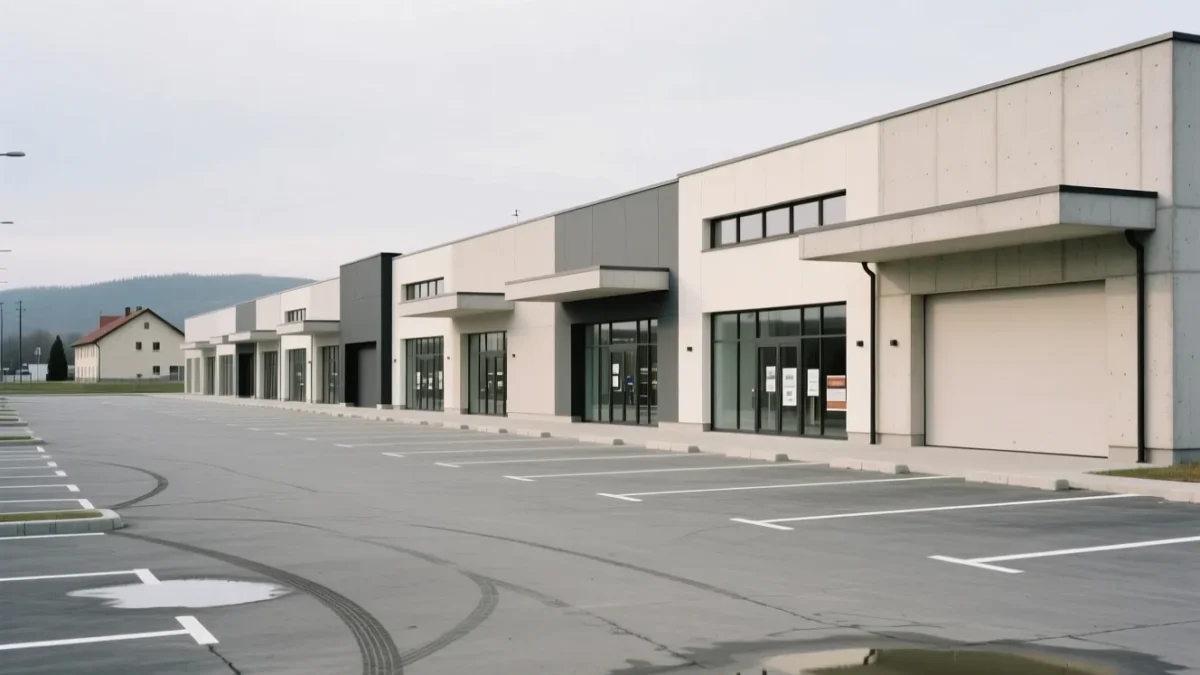
Across Slovakia, the next square metre of retail is going up beside a road, well outside the big malls. While the public image of retail property is still defined by large shopping centres, the real growth in floor space has moved over the past two years to an entirely different format.
This analysis is not about how much retail Slovakia has or how weak the consumer is. It asks one question: why capital is choosing the smaller format. The usual answer — because it is cheap — turns out to be only half right, and the half that is wrong points to something more interesting.
A record that was not set in shopping centres
The defining figure of 2025 does not belong to shopping centres. Retail parks delivered record new supply of roughly 95,000 sqm, with a further 100,000 sqm or so planned for 2026, according to Cushman & Wakefield Slovakia. The fourth quarter confirmed it: the market added roughly another 38,000 sqm of leasable space specifically in the park format, per CBRE Slovakia.
The pipeline has not stopped. Around 73,000 sqm is under construction across 14 projects, the majority in western Slovakia, per CBRE. The first quarter of 2026 added a further 30,000 sqm or so across four schemes.
A methodological note is warranted. Cushman & Wakefield puts the pipeline closer to 80,000 sqm — but as supply projected for 2026, not volume under construction. The difference is not an error; it reflects different definitions, cut-off dates and counting rules. Both figures belong side by side rather than averaged. What matters is the direction on which both consultancies agree.
For scale, nine new retail parks with combined leasable area of over 61,000 sqm were due to open in 2025, including two formats above 10,000 sqm — OC Klokan in Žilina and Retail Park Podunajská brána. Modest numbers against the world of large centres, yet in aggregate they define where construction is going.
The rent gap, and which direction it is moving
The shift is usually explained by a single number: prime rent of around €100 per sqm per month in a shopping centre against around €15 in a retail park, per Cushman & Wakefield’s Investment MarketBeat for Q3 2025. A gap of more than six times.
More recent data from a different house gives a different picture, and it should be set alongside rather than replaced:
| Source | Shopping centre prime | Retail park prime | Ratio |
|---|---|---|---|
| Cushman & Wakefield, Q3 2025 | ~€100/sqm/month | ~€15/sqm/month | ~6.7× |
| CBRE Slovakia, Q4 2025 | €78/sqm/month | €18/sqm/month | ~4.3× |
Neither is wrong. Prime is defined against different reference assets, samples and dates, and the two should not be averaged. But the more consequential point is the direction of travel, and it cuts against the standard explanation.
On CBRE’s data, retail-park rents are rising faster than shopping-centre rents. Quarter on quarter, prime moved from €70 to €78 in centres and from €16 to €18 in parks — year-on-year increases of 11% and 13% respectively.
That complicates “capital chooses parks because they are cheap.” The format is cheaper in absolute terms, and that matters. But its rent is climbing faster, which is what one expects where demand for a format is outstripping the supply of suitable sites. The more accurate reading is that parks are not so much a discount refuge as the segment where pricing power currently sits — and a developer entering now is buying into a rising rent line, not a static cheap one.
The economics underneath
The rent difference still reflects a real cost difference on both sides.
For a tenant — particularly a grocery discounter, drugstore, sports, pet, footwear or home-goods retailer — the primary variable is not the prestige of the address but the cost of turnover generated per square metre. A roadside format with its own entrance, adjacent parking and a lower entry rate keeps occupancy cost at a level where the store is profitable on a cautious average basket. A shopping centre offers concentrated footfall, but at a price a low-margin range cannot sustain across a large floorplate.
On the developer’s side, a retail park is single-storey and structurally simple: no costly common areas, escalators, extensive HVAC and fire-safety systems, or long internal promenades that generate cost while selling nothing. Lower construction cost and shorter build time mean the project clears its return at substantially lower rent per metre — which is precisely what opens the format to towns a large centre could never sustain.
Behind the rent gap sits a different pattern of customer behaviour. A shopping centre thrives on the longer, experience-led visit with a higher share of discretionary purchase — apparel, electronics, dining. The park is built on the opposite: the short, repeated, purpose-driven trip where the customer heads deliberately for one or two units.
One qualifier on the resilience argument. That model is often described as more robust in a cautious consumer environment because it rests on regular purchases of essential categories. The 2025 data supports that across the year but not in every month: in December 2025, hyper- and supermarkets fell 2.5% in real terms, so the grocery anchor did not hold in the single month owners count on most. Defensive is not the same as immune.
Why mostly the west, and why smaller towns
The geography is not random. That the majority of the 73,000 sqm under construction is heading to western Slovakia reflects two things at once: purchasing power concentrated around the Bratislava–Trnava axis, and the logic of filling in the network where a modern format within driving distance is still missing.
This is where the park model has the advantage. A shopping centre needs a large catchment with sufficient density and purchasing power to support dozens of tenants and a costly operation. A park can be sustained by a smaller market — a district town, a large village, a suburb — because its operating equation is simpler. It does not need to draw visitors for a whole-day outing; it needs to capture the regular purposeful purchase on the way to or from work.
Slovakia already has the highest density of modern retail space in Central Europe, around 435 sqm per 1,000 inhabitants against 365 in the Czech Republic, 359 in Poland and 326 in Hungary. The large agglomerations are essentially covered; the room to grow lies in the smaller catchments the cheaper format can serve.
The result is a decentralisation of the retail map. Where the previous cycle built large centres in regional capitals, the current wave is thickening the network across second- and third-tier towns — exactly where the park’s economics work and the large centre’s do not.
Shopping centres are not in crisis — they have stopped growing by floor space
The shift is easily mistaken for decline. The data does not support that reading. Tenant turnover in shopping centres rose roughly 1% year on year in 2025, while footfall in Q4 rose faster, by about 2% — roughly flat across the full year. That is a format that has matured, not one that is collapsing.
A mature market behaves differently from a growing one. Established centres retain their visitor flow and modestly rising turnover, but value is no longer created by adding metres. It comes from working the tenant mix, remodelling, adding food and service offers, and optimising existing space. Growth by floor space moved to the parks because uncovered demand remains there at lower risk.
The two formats are therefore not competing for the same thing. The centre defends its position on experience quality and brand concentration; the park expands on accessibility and cost efficiency.
For a centre landlord, the conclusion is specific: occupancy measured by leased units has stopped being a sufficient measure of performance. What decides value is turnover per square metre and the ability to hold a mix that generates it.
What it means for investors and landlords
Retail remains a strong asset class in Slovakia: in the first half of 2025 it took 44% of all commercial property investment, with total volume of €418 million, up 170% year on year, per CBRE. The question is not whether to invest in retail but into which format.
Here the yields matter more than the rents, and they are closer than the format difference implies. Investment yields held stable at 6.50% for shopping centres against 6.75% for retail parks. A 25-basis-point spread is narrow for two formats with markedly different tenant profiles, lease structures and operating burdens — and it tells you how the market currently prices convenience-led retail relative to large centres.
The practical trade-off:
- Retail park: lower entry cost, shorter build, simpler operation, defensive tenant range holding footfall in a cautious environment — and rents rising faster than the alternative.
- Shopping centre: higher rent per metre, but higher operating cost, more demanding mix management, greater sensitivity to discretionary spending swings, and value creation through asset management rather than expansion.
Shorter build time carries its own value in a cautious cycle. A park can be built, leased and opened faster than a large centre, which shortens the period capital sits tied up without return and reduces exposure to conditions changing between decision and opening. It also allows demand to be met in increments — several smaller, independently viable projects rather than one large bet.
For a tenant, the shift is a source of negotiating leverage. With two functioning formats and record new park supply, an expanding chain has more siting options across cost tiers. The caveat is that the cheaper tier is getting less cheap: at 13% annual rent growth, the arbitrage between formats is narrowing.
Conclusions
Slovak retail in 2026 is not undergoing a crisis of format but a shift of it. Roughly 95,000 sqm of record new park supply in 2025, another 100,000 sqm planned for 2026, some 73,000 sqm under construction mostly in the west, and 30,000 sqm more delivered in the first quarter show where capital is flowing.
The reason is economics, but not simply cheapness. The absolute rent gap remains large — somewhere between four and seven times depending on whose definition of prime is used — and lower construction costs genuinely open the format to towns a large centre cannot sustain. But park rents are rising faster than centre rents, 13% against 11%, which means the format is being repriced upward as demand meets a limited supply of sites.
Shopping centres, meanwhile, are not failing. Turnover rose modestly and footfall a little faster, but they have left growth by floor space behind and now create value by working the mix rather than expanding it. With yields only 25 basis points apart, the choice between formats is less about risk premium than about what kind of asset management an owner is equipped to do.
Figures reflect Cushman & Wakefield and CBRE reporting on 2025 and early 2026 and were current at the time of writing. The two consultancies use different market definitions and their prime rent figures are not interchangeable or averageable. General information on commercial property markets. Not investment, tax or legal advice.