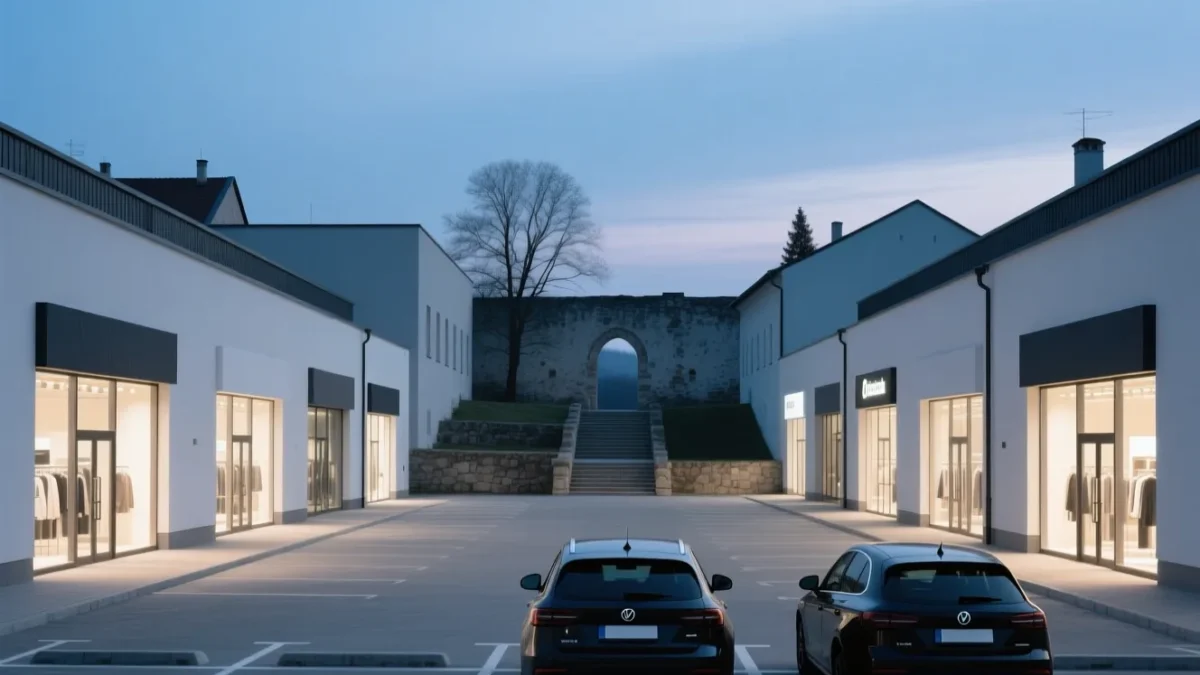
The most saturated retail market in Central Europe is not the one with the healthiest consumer. That is precisely what is happening in Slovakia in 2026. With a density of roughly 435 sqm of modern retail space per 1,000 inhabitants, Slovakia is, according to Cushman & Wakefield (Central European retail data, February 2026), the most saturated retail market among the larger economies of Central Europe — ahead of the Czech Republic, Poland and Hungary. In the same period, the Statistical Office of the Slovak Republic (Štatistický úrad SR) recorded a 1.2% real decline in retail sales for the full year 2025, and a 5% year-on-year drop in December alone. Supply is expanding at record levels; household demand is weakening. That contradiction is not a statistical error — it is the single most important key to reading the Slovak retail market this year.
The densest retail network in the region
The figure that defines Slovak retail in 2026 is density. According to Cushman & Wakefield, Slovakia holds approximately 435 sqm of modern retail space per 1,000 inhabitants (as of February 2026). For comparison, the same measure stands at 365 sqm in the Czech Republic, 359 sqm in Poland and 326 sqm in Hungary. Slovakia therefore leads the region by a margin that is far from marginal — against Hungary, the gap is close to a third.
High density is, in itself, neither a virtue nor a flaw; it is a structural fact that must be read in context. It means the average Slovak resident has access to more modern retail square metres than a resident of any other larger Central European country. For a developer, that signals a market approaching its absorption ceiling; for an existing centre owner, it means sharper competition for the same shopper. And precisely when that shopper is under pressure, the question of saturation stops being academic.
Density, moreover, is unevenly distributed. Modern floor space has historically concentrated around Bratislava and the larger regional cities, while smaller district towns remained undersupplied for years. That very imbalance is the engine of new construction — and it explains why the market, despite overall saturation, continues to produce record volumes of new space in one specific format.
A record year for retail parks
New supply did not stall in 2025 — on the contrary, it hit a record. According to Cushman & Wakefield Slovakia, retail parks delivered a record 95,000 sqm of new supply in 2025, with a further roughly 100,000 sqm planned for 2026 (Market Outlook 2026). CBRE Slovakia (Retail Figures Q4 2025) records that in the final quarter of 2025 alone, a further 38,000 sqm of leasable space was added in this format.
Under construction, according to CBRE Slovakia (relayed by Property Forum), is approximately 73,000 sqm of new retail space across 14 projects, predominantly in western Slovakia (as of 2025/2026). A methodological note: Cushman & Wakefield cites a higher figure of around 80,000 sqm — but as supply projected for 2026, not volume under construction; it is a different definition, cut-off date and counting rule. These differences should not be averaged, but read with their source and date.
By the close of 2025, according to Cushman & Wakefield Slovakia, nine new retail parks with a combined leasable area of over 61,000 sqm were expected to open, two of them exceeding 10,000 sqm — OC Klokan in Žilina and Retail Park Podunajská brána. The retail-park format has thus become the dominant channel of growth for Slovak retail: it is cheaper to build, faster to bring to market, and better suited to smaller towns where a large shopping centre would lack sufficient catchment. That is exactly why it keeps growing even in a year when consumption is falling.
The consumer who isn’t buying
The other side of the equation is far less optimistic. According to the Statistical Office of the Slovak Republic, real retail sales — that is, sales adjusted for inflation — fell 1.2% year on year across the whole of 2025, with six of the nine tracked segments ending in real decline. This was not a one-off dip but a trend that deepened over the course of the year.
The monthly dynamic makes it plain: in October 2025 retail was still growing at 0.6% year on year, but in November it fell 3.2% (the worst result in eleven months), and in December it dropped 5% year on year — the worst monthly result of the entire year, according to the Statistical Office of the Slovak Republic (Retail turnover, December and full-year 2025). December — traditionally the strongest shopping month of the year, when centres count on peak Christmas turnover — delivered instead the deepest contraction.
The structure of that decline matters as much as its depth. According to the Statistical Office of the Slovak Republic, hypermarkets and supermarkets held a modest real gain of around 1.3%, and specialised stores (textiles, footwear, pharmaceuticals, cosmetics) rose 4.4%, while e-shops and mail-order sales fell more than 7% in December. In other words, households did not stop buying groceries and essentials, but they sharply cut back on discretionary and online spending. This is the classic profile of a consumer under pressure: buying what must be bought, deferring what can be deferred.
The paradox of saturation and weak demand
This is where the two stories meet. On one side, the densest retail network in Central Europe and record retail-park construction; on the other, a real decline in retail sales and consumer caution. How can both hold at once?
The explanation lies not in a contradiction in the data but in the different time horizons these figures measure. Retail space is planned and built on a five-to-ten-year outlook; a developer opening a retail park today is not betting on this December’s spending but on the region’s demography and purchasing power over the medium term. A weak 2025 is, for that developer, a cyclical phenomenon, not a structural break. Retail sales, by contrast, measure what is happening right now — and right now, real wages and consumer confidence are not at a level that would fill new floor space with turnover overnight.
The consequence is tangible for owners: a gap between occupancy and performance. According to CBRE Slovakia (Retail Figures Q4 2025), tenant turnover in shopping centres rose only about 1% year on year in 2025, while footfall in Q4 2025 alone rose faster, by about 2% (roughly flat for the full year). A centre can be full, its visitor numbers even rising — and yet sales per square metre stagnate. A full centre and a centre that sells have stopped being synonymous.
Two tiers of rent, and what holds them up
Saturation and weak consumption also feed into rents, which operate on the Slovak retail market at two markedly different tiers. According to Cushman & Wakefield Slovakia (Investment MarketBeat Q3 2025), prime rent in a shopping centre reaches approximately 100.00 €/sqm/month, while in a retail park it is only around 15.00 €/sqm/month. A gap of nearly sevenfold.
That chasm explains why growth is heading precisely into retail parks. A tenant facing weakening consumption looks for a format with a lower fixed-cost burden — and the retail park offers exactly that, at a fraction of a prime centre’s rent, with better car access and lower operating costs. For the developer it is a format with faster payback; for the tenant, a way to stay present in the market without carrying the prime rent of a large centre. Prime shopping-centre rates are holding, but they are held up by a limited supply of the best locations, not by the strength of consumer demand — a distinction every owner should read with caution.
Investors are still betting on retail
Despite the weak consumer, retail remains at the centre of investor attention. According to CBRE Slovakia, investment in commercial real estate in Slovakia reached 418 million euros in the first half of 2025, a 170% year-on-year increase, with retail accounting for as much as 44% of all investment (as of H1 2025). Retail was thus the single largest asset class on the Slovak commercial-property market in the first half of the year.
The apparent paradox — investor appetite amid falling consumption — has the same explanation as the record construction: the investor is not buying last year’s turnover but the future stream of rental income. Stable tenants, long leases and the resilience of grocery anchors make retail, especially convenience-oriented retail parks, a defensive asset class in uncertain times. While December sells 5% less, leased square metres keep generating rent — and it is that rent, not current consumption, that the investor is buying.
What this means for developers, tenants and investors
The correct reading of 2026 is neither „consumption has recovered“ nor „the saturated market has stalled.“ It is a market in a repositioning phase, where occupancy alone has ceased to be a sufficient indicator of performance.
For the developer, this means record retail-park construction is justified only where a region has genuine medium-term catchment and purchasing power — a density of 435 sqm per 1,000 inhabitants is a warning that the absorption ceiling is near, and new projects will increasingly compete for the same, more cautious shopper. For the tenant, the choice of format and cost structure is decisive: a retail park at 15 €/sqm carries a different risk profile under weak consumption than a prime centre at 100 €/sqm. For the investor, the decisive variable stops being occupancy and becomes sales per square metre and the sustainability of rental streams — an occupied centre that does not sell is a source of risk, not certainty.
Conclusions
Slovakia enters 2026 as Central Europe’s most densely supplied retail market — with roughly 435 sqm of modern space per 1,000 inhabitants, according to Cushman & Wakefield — and, simultaneously, with real retail sales that fell 1.2% across 2025 and 5% in December, according to the Statistical Office of the Slovak Republic. Record retail-park construction (95,000 sqm in 2025, a further roughly 100,000 sqm planned for 2026) and an investor appetite in which retail made up 44% of first-half 2025 volume are all playing out above a consumer who is cutting discretionary and online spending. The contradiction is not a flaw in the data but a difference of horizons: space is built for a decade, turnover is measured by the month. For every market participant the lesson is the same — occupancy alone is no longer enough, and the decisive figure becomes sales per square metre, which has yet to catch up with Slovak demand in 2025.
General information on commercial property markets. Not investment, tax or legal advice.