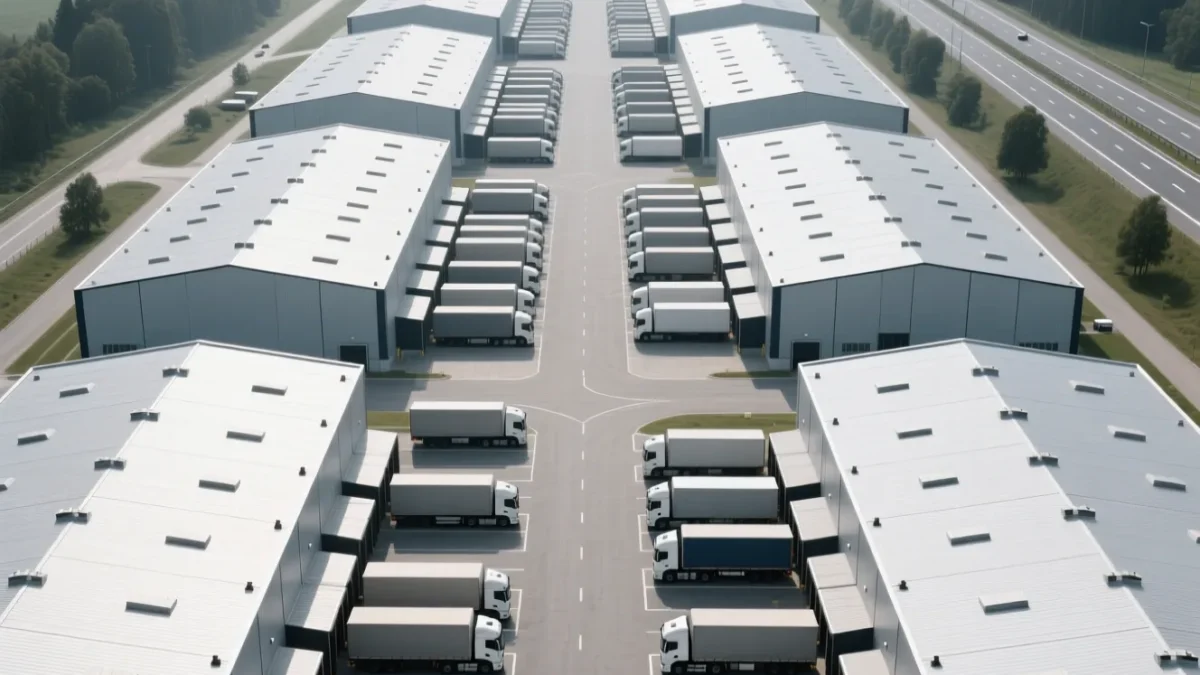
When an investor seeks a Class A hall along the D1 corridor, retail or e-commerce is usually the secondary reason. The primary one is an assembly line half an hour away and the supplier chain that must deliver every component precisely when that line consumes it.
The number most often quoted to prove it: automotive accounted for 31% of demand for warehouse and industrial space in the first quarter of 2026, just ahead of third-party logistics at 30%, according to CBRE Slovakia.
That figure is accurate and it is routinely over-read. Three qualifiers change what it means, and none of them usually appears alongside it.
What the 31% actually measures
Total leasing in Q1 2026 reached around 136,000 sqm, up 47% year on year, with net leasing of roughly 59,000 sqm, up 35%. But the composition matters more than the total: renegotiations formed 53% of all leases. Pre-leases were 26%, new leases 16%, short-term 4% and expansions 1%.
So the automotive share of 31% sits on a demand figure that is majority renewal of existing agreements. That is a sign of stability rather than expansion — suppliers holding the space they have, not taking more of it. For a developer underwriting speculative construction, the distinction is decisive.
The regional split points the same way. The wider Bratislava area took 72% of leasing activity, western Slovakia 22% and eastern Slovakia just 6%.
Vacancy: the map the article usually skips
Vacancy rose slightly to 8.12% in Q1 2026, a quarterly increase of 31 basis points. The national figure conceals a spread wide enough to change a siting decision:
| Region | Vacancy | Share of Q1 leasing |
|---|---|---|
| Eastern Slovakia | 2.66% | 6% |
| Wider Bratislava | 6.92% | 72% |
| Central Slovakia | 9.83% | — |
| Western Slovakia | 10.27% | 22% |
The east has the tightest market in the country and the smallest share of activity. That is the signature of a region where supply has not yet been built for demand that is expected rather than present — which is precisely the Volvo effect, and precisely why it should not yet be read as a completed shift.
The west, meanwhile, carries the highest vacancy and most of the automotive supplier base. Those two facts sit uneasily together and are the real tension in this market.
Two consultancies, two readings
Headline figures for the same quarter differ by more than the quarterly movement:
| Metric | CBRE Slovakia | Cushman & Wakefield |
|---|---|---|
| Prime rent | €5.95/sqm/month | €5.30/sqm/month |
| Vacancy | 8.12% | 7.72% |
| New space delivered | 83,000 sqm | 105,000+ sqm |
A 65-cent gap on prime rent is roughly 12%. The definitions, samples and cut-offs differ; the figures should be cited with their source and not averaged.
Total modern stock reached 4.87 million sqm, with around 178,000 sqm under construction, all scheduled for delivery during 2026.
Why a carmaker decides where a hall stands
The logic is industrial, not speculative. Slovak automotive production runs on just-in-time and just-in-sequence models: components do not sit in a buffer, they go to the line at the exact time and in the exact assembly order.
The spatial consequence is direct. A Tier 1 supplier cannot sit three hundred kilometres from final assembly; it must be within a radius allowing several deliveries a day without risking a line stoppage. Tier 2 suppliers — supplying parts to Tier 1 — can afford greater distance but stay within the regional corridor. The result is a layered geography: a core beside the plant, a ring along the motorway, and general logistics serving several plants at once.
What looks like a map of industrial parks is a map of four gravitational fields. Industrial property here is a derivative of manufacturing strategy, not a standalone market.
2025 in plant numbers — including the declines
Slovakia built roughly 1.07 million vehicles in 2025, up 7.7% from 993,583 in 2024, per ZAP SR. The country holds the world’s highest per-capita production at 196 vehicles per 1,000 inhabitants.
The plant-level detail is where the standard account goes wrong:
| Plant | 2025 output | Change |
|---|---|---|
| Volkswagen Bratislava | 336,905 | −1.2% |
| Stellantis Trnava | 330,000 | The only plant to grow |
| Kia Žilina | 296,550 | −15.6% |
| Jaguar Land Rover Nitra | 107,000 | — |
A figure of 377,000 for Trnava circulates widely; it was the target, not the outcome. Actual output was 330,000, and Trnava was the only Slovak plant to raise production year on year, on the back of the Citroën C3 and Opel Frontera including electric versions. Its current models are the Citroën C3, C3 Aircross and Opel/Vauxhall Frontera in combustion, hybrid and electric variants — the Peugeot 208 is no longer built there.
The other three had a difficult year. Kia was preparing its transition to new and electric models, which only entered production in 2026. Volkswagen Bratislava and Jaguar Land Rover Nitra suffered from falling exports of premium SUVs to the US and Chinese markets, and the Nitra plant additionally halted production for over a month after a cyberattack in September. Bratislava is ending Touareg production this year and, while shifting toward electrified versions of the Porsche Cayenne and Audi Q8, still has no fully electric model in its portfolio.
ZAP’s own outlook for the next three years is relatively pessimistic: after the Volvo Košice plant opens, total national production is expected to plateau rather than continue climbing.
That is the demand base industrial parks are attached to. It is stable and very large; it is not currently growing.
The electric transition, and how far it has actually got
The emblem is Volvo Cars at Valaliky near Košice: a €1.2 billion, EV-only plant with planned first-phase capacity of 250,000 vehicles a year and an option to expand toward half a million.
Its progress is further along than most coverage suggests. More than 600 robots have been installed in the body shop. Functional testing of the technology began in the first half of 2026, and the plant has already produced its first 100 test bodies, sent to Sweden for quality inspection. At the turn of summer and autumn 2026 it is starting pre-series test operation, with the first complete prototypes — including sister-brand Polestar models — coming off the lines. Commercial production starts in 2027.
The specific Volvo model has not been officially disclosed; it is a next-generation Volvo and it is not the EX30, which is built in Ghent. The Polestar 7 is confirmed for the site: a compact luxury SUV on the SPA3 platform, related to the Volvo EX60, with production scheduled from 2028.
Kia’s Žilina transition is also further along than usually reported. The plant launched the electric EV4 in August 2025 and began production of the EV2, a subcompact electric crossover, in March 2026 — two electric models, not one. The underlying investment is around €108 million spread across 2024 to 2028, supported by a €30 million tax holiday.
Alongside these sit the Gotion-InoBat battery gigafactory in Šurany at €1.2 billion and the Hyundai Mobis EV-module plant in Nováky at around USD 257 million. Battery and module plants carry different spatial requirements than classic assembly — higher energy intensity, specific logistics flows, greater sensitivity to proximity to the off-taker.
Nearshoring: continuation, not novelty
Nearshoring has become a stock argument for Central Europe. For Slovakia it is not a new thesis but the continuation of a logic that has held for two decades: the supplier must be near the line. What is new is the pressure carmakers face to shorten and secure chains after a run of global disruptions.
The demand this generates is served by developers with confirmed presence in the country — CTP, Prologis, P3, Panattoni and VGP — centred on Bratislava, the D1 corridor and the areas around Nitra, Trnava, Žilina and Košice. CTP is Europe’s largest listed owner and developer of industrial property, with an average market share of 28.2% across key countries and a European portfolio of 13.5 million sqm as of mid-2025. Slovakia-only portfolios are not publicly broken out and are therefore not cited here as figures.
What follows for industrial parks
Demand is tied to the automotive cycle, and that cycle is flat. At 31% of leasing, sector swings feed through to park occupancy faster than seasonal movements in retail or e-commerce. With three of four plants declining in 2025 and ZAP projecting a plateau, the base case is stability rather than growth.
The eastward shift is real but not yet visible in leasing. Eastern vacancy at 2.66% shows a tight market; eastern leasing at 6% of the national total shows it is still small. The Volvo effect will register in these figures from 2027 onward, not before. A developer positioning for it is building ahead of demonstrable demand — which is the opportunity and the risk in the same sentence.
The west carries the vacancy. At 10.27% it holds the highest availability alongside most of the supplier base. Renegotiation-heavy demand there argues for asset management and retention rather than speculative addition.
New typologies, not just new locations. Battery and module plants need higher power connections and different logistics profiles than a classic Tier 1 hall. That is a specification question as much as a geography one.
Conclusions
Slovakia’s industrial-park market is a derivative of the car industry, which made up 31% of Q1 2026 demand. But that demand was 53% renegotiation, 72% concentrated in the Bratislava area, and it rests on a manufacturing base where only one of four plants grew in 2025 and the national association expects a plateau once Volvo opens.
The electric transition is redrawing the map eastward — Volvo at Valaliky entering pre-series operation now, Kia already building two EVs in Žilina, battery plants in Šurany and Nováky. Eastern vacancy of 2.66% against western 10.27% shows where the tightness is. But eastern leasing at 6% of the national total shows the shift is anticipated rather than accomplished.
For the investor and developer, the conclusion holds with a sharper edge: read demand through the assembly line, the Tier 1/2 geography and the direction of electrification — and read it against a production base that is stable rather than expanding, in a market where more than half of all leasing is existing tenants staying put.
Figures reflect CBRE, Cushman & Wakefield and ZAP SR reporting on 2025 and Q1 2026 and were current at the time of writing. The consultancies use different market definitions and their prime rent and vacancy figures are not interchangeable. Plant-level production figures are ZAP SR aggregates and should be confirmed with the association for precision work. General information on commercial property markets. Not investment, tax or legal advice.