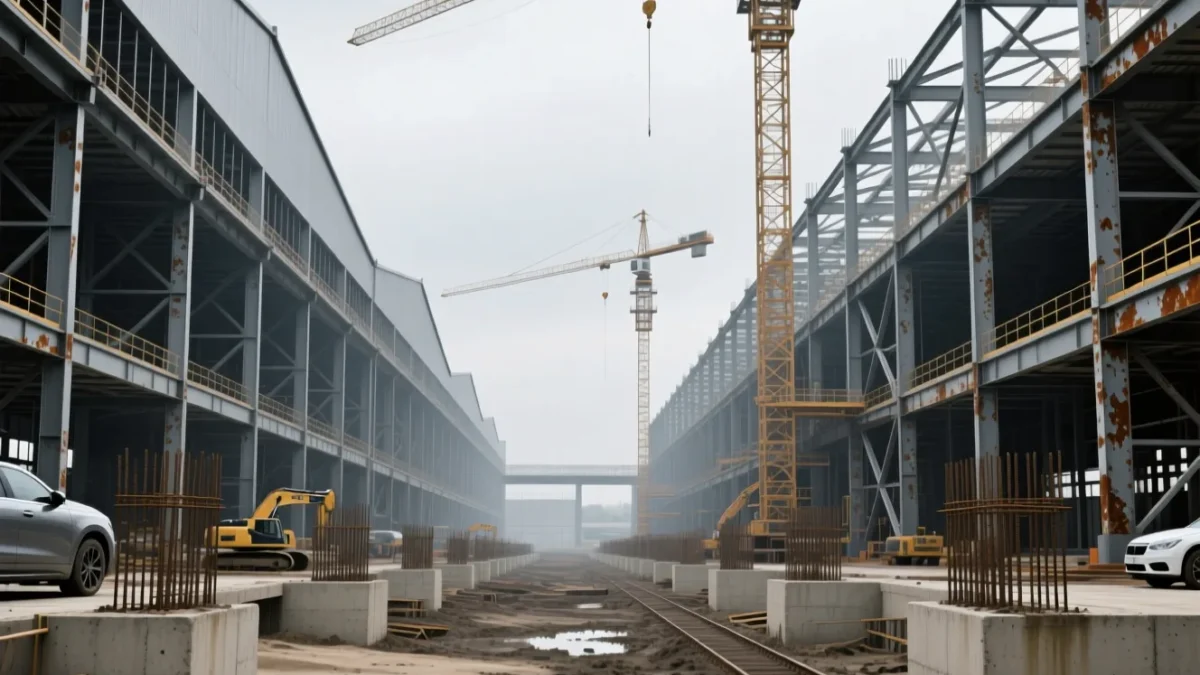
The tightest warehouse market in Slovakia is not the region where the most space is leased. Vacancy in the east stood at just 2.66% in the first quarter of 2026 — the tightest in the republic — while the west still held 10.27% of its stock empty. Yet over the same period only 6% of leasing activity went east, against 72% for the Bratislava region.
The east is both the fullest and the least-served market on the national map. Into that imbalance arrives Volvo’s EUR 1.2 billion plant near Košice, with commercial production due in 2027.
Most coverage treats the property response as a question for the future. It is not. The halls are already going up, the supplier park already has a second confirmed investor, and the answer to “who will build” is on the record.
Volvo Košice: confirmed, unknown, and further along than reported
The confirmed core: approximately EUR 1.2 billion, planned first-phase capacity of 250,000 vehicles a year with an option to expand toward half a million, and an electric-only orientation. Series production was pushed from 2026 to 2027.
The plant is considerably further along than the “due in 2027” framing suggests. More than 600 robots have been installed in the body shop. Functional testing of the technology ran through the first half of 2026, and the plant has already produced its first 100 test bodies, sent to Sweden for quality inspection. At the turn of summer and autumn 2026 it is entering pre-series test operation, with the first complete prototypes — including sister-brand Polestar models — coming off the lines.
What is genuinely not confirmed is the model. Volvo speaks only of a next-generation vehicle. The recurring assumption that this is the EX30 is wrong: the EX30 is built in Ghent, Belgium. Without a named model and its volume plan, any precise estimate of downstream supplier demand is a scenario, not a forecast.
The Polestar programme, on the other hand, has firmed up beyond the memorandum stage often cited. Polestar confirmed in 2025 that the Polestar 7 — a compact luxury SUV on the SPA3 platform, related to the Volvo EX60 — will be built at Košice, with production scheduled from 2028. It will be the brand’s first European-built model.
Valaliky Industrial Park: the actual property vehicle
The project people call “Volvo near Košice” is, in real-estate terms, the Valaliky Industrial Park — a strategic park delivered through a state company of the same name, established by the economy ministry to execute the commitments of the investment agreement.
The land arithmetic sets the ceiling on everything that follows. Of 341 hectares assembled across the park, 281.2 hectares go directly to Volvo Cars Košice. That leaves roughly sixty hectares for the supplier park itself. Assembling it required 1,306 purchase contracts and 153 expropriation proceedings that became final.
Employment projections give the demand scale: close to 7,200 people at the park, rising toward 16,000 including subcontractors.
The enabling infrastructure is public and priced. A tender covering the park’s transport infrastructure — rail, roads, data and low-voltage networks — was put out at an estimated value above EUR 185 million. Connection runs to the R4 expressway and the I/17 road, with the R2 Šaca–Košické Oľšany II under construction to complete the frame. Gas supply required 4,125 metres of high- and medium-pressure pipeline.
For a developer, the sixty-hectare figure is the operative constraint. A supplier park of that size cannot absorb the full Tier 1 and Tier 2 belt a 250,000-unit plant generates — which is precisely why demand will spill into the wider Košice and Prešov market.
Who is already building — the question is answered
The standard framing asks whether developers will build speculatively in the east ahead of signed leases. They are already building, and two projects are far enough along to have been nominated in this year’s industrial developer awards.
CTP is developing CTPark Prešov North, including hall PRSN02 — over 31,000 sqm of lettable space built to suit for DEJONG Slovakia. The park is described as one of the most significant industrial parks in eastern Slovakia, combining production and logistics space with an emphasis on energy efficiency and future tenant expansion.
Sibareal is building Logis One Park Košice, an extensive industrial complex located in the Valaliky cadastre itself.
CTP remains Europe’s largest listed owner and developer of industrial property, with an average market share of 28.2% across key countries and a European portfolio of 13.5 million sqm as of mid-2025. Prologis, P3, Panattoni and VGP are also active in Slovakia, though Slovakia-only portfolios are not publicly broken out.
The relevant question has therefore shifted. It is no longer whether the market takes Košice seriously — it does — but whether the pace of construction matches a supplier base that must be operational alongside the assembly line rather than after it.
The ecosystem is forming, and it is not only automotive
The clearest evidence that the cluster logic is working arrived in June 2026, and it came from a different industry.
The Chinese group GATD, through Slovakia Advanced Material, confirmed an investment of roughly EUR 105 million in an aerospace and energy components plant in the southern part of the Valaliky park, in the Geča cadastre. It will create 335 jobs — 192 in production, 143 in administration, logistics, sales and support — with construction from December 2026 to the end of 2028, comprising intelligent forging lines, isothermal ring rolling, automated heat treatment and physico-chemical testing facilities.
The investor’s stated reasons matter as much as the sum. Alongside the D1 motorway, the R2 and R4 expressways, rail infrastructure and proximity to Košice airport, it explicitly cited the concentration of industrial firms in the region and the development of the supplier base forming around the upcoming Volvo plant.
That is the agglomeration argument working in real time — and working across sectors, which makes the eastern demand base less concentrated than a pure automotive read would suggest.
The wider electric chain
Košice does not stand alone in Slovakia’s electric transition, though the other pieces sit further west. The Gotion-InoBat joint venture is building a battery gigafactory in Šurany at EUR 1.2 billion, comparable in scale to the Volvo plant. Hyundai Mobis is building an EV-module plant in Nováky at around USD 257 million. Kia invested roughly EUR 108 million near Žilina, launching the electric EV4 in August 2025 and adding the EV2, a subcompact electric crossover, from March 2026 — two electric models, not one.
For property, the significant point is the tenant profile. Battery and module production brings higher demands on energy infrastructure, stricter fire and safety standards for halls, and typically longer lease terms reflecting capital intensity. A hall for a Tier 1 battery supplier is not the same product as one for a classic logistics operator.
The production base, read accurately
Slovakia built roughly 1.07 million vehicles in 2025, up 7.7% from 993,583 in 2024, holding the world’s highest per-capita output at 196 vehicles per 1,000 inhabitants. The plant-level picture, per ZAP SR, is less uniform than usually reported:
| Plant | 2025 output | Change |
|---|---|---|
| Volkswagen Bratislava | 336,905 | −1.2% |
| Stellantis Trnava | 330,000 | The only plant to grow |
| Kia Žilina | 296,550 | −15.6% |
| Jaguar Land Rover Nitra | 107,000 | — |
A figure of 377,000 for Trnava circulates widely — it was the target, not the outcome. Trnava reached 330,000 on the Citroën C3, C3 Aircross and Opel Frontera, including electric versions; the Peugeot 208 is no longer built there.
ZAP’s own three-year outlook is relatively pessimistic: once Volvo Košice opens, total national production is expected to plateau rather than climb. Košice, in other words, may redistribute Slovak automotive output geographically more than it expands it — which is a different proposition for the west than for the east.
What it means for eastern industrial property
The opening paradox resolves into a specific dynamic. With vacancy at 2.66%, the east has no cushion of empty space from which new demand could immediately draw. Eastern vacancy fell from 3.81% in Q3 2025 to 2.66% in Q1 2026, while the west held above 10% across the same span.
Two consequences follow.
Construction pressure precedes the ramp-up. Suppliers operating on just-in-time and just-in-sequence terms must be ready alongside the start of assembly, not after it. With only around sixty hectares available inside the Valaliky supplier park, that demand necessarily spills into the wider Košice and Prešov market — which is where CTP and Sibareal are already positioned.
Rents should converge toward national levels. Prime warehouse rent in Slovakia rose from EUR 5.80 to EUR 5.95 per sqm per month between H1 2025 and Q1 2026, with total modern stock expanding from 4.64 to 4.87 million sqm. Eastern rents, which have reflected a thin peripheral market, have room to move.
One qualifier on the national demand figure. Automotive accounted for 31% of Q1 2026 demand, ahead of 3PL at 30%, e-commerce 17%, retail 11% and manufacturing 10%. But 53% of all leasing in that quarter was renegotiation of existing agreements, with new leases at just 16%. The sector’s dominance describes a stable occupier base more than an expanding one.
Note also that the two major consultancies read the same quarter differently: CBRE has prime rent at EUR 5.95 and vacancy at 8.12%, while Cushman & Wakefield has EUR 5.30 and 7.72%. The figures should be cited with their source rather than averaged.
Risks
The timeline has already slipped once. Speculatively built halls standing empty weigh more heavily in a thin eastern market with a limited pool of alternative tenants than in the deep Bratislava market.
The model is undisclosed. Without it, the volume plan — and therefore the number and size of suppliers — remains a scenario.
Concentration. A region whose industrial demand rests on one dominant off-taker and its chain is more exposed to the automotive cycle than the diversified west. The GATD investment cuts against this to a degree, and further non-automotive arrivals would cut against it further.
Electric demand itself is unpredictable, which feeds into volume decisions and therefore into how much supplier space around the plant is actually occupied.
Conclusions
Volvo’s plant at Valaliky is the strongest signal that Slovakia’s industrial gravity is shifting east, and the shift is further along on the ground than in the coverage. The plant is entering pre-series operation now; Polestar 7 is confirmed for 2028; CTP and Sibareal are already building in Prešov and in the Valaliky cadastre; and a EUR 105 million aerospace investor has cited the emerging Volvo supplier base as a reason for choosing the site.
The constraint is arithmetic. Of 341 hectares assembled, 281.2 go to Volvo, leaving roughly sixty for suppliers — in a region where vacancy is 2.66% and only 6% of national leasing lands. Demand will exceed what the park itself can hold.
For developers and investors the message is not that the east has arrived, but that readiness must lead the assembly line rather than chase it — and that with a model still undisclosed and a schedule that has slipped once, discipline in reading the facts still separates a prudent commitment from a premature one.
Figures reflect CBRE, Cushman & Wakefield, SARIO, ZAP SR and Valaliky Industrial Park reporting current at the time of writing. The consultancies use different market definitions and their figures are not interchangeable. Land, employment and infrastructure figures for the park derive from public tender and project communications and should be confirmed against current filings. General information on commercial property markets. Not investment, tax or legal advice.